Sunday, October 7, 2012

Bad Boys Bad Boys, Whatcha Gonna Do?


I wrote this from an aboriginal community called Kintore. It’s in the desert, about a five-hour drive on mostly dirt roads from Alice Springs, a small town in central Australia that’s roughly 1,500 miles away from any metropolitan area. And then there’s the fact that Australia itself is approximately 14 hours from the US by plane.

In other words, I’m about as close to the middle of nowhere as you can get in 2012. And yet, when I walked into Kintore’s dialysis unit, there was a television set up, and it was playing Bad Boys 2: The Baddening. (I may have made up the part after the colon. It’s impossible to know for sure.)

The sheer reach of American entertainment continues to amaze me. It would seem to defy logic that one could travel to a desert halfway around the world and find two aboriginal Australians who don’t speak great English watching Martin Lawrence and Will Smith do…umm…you know, I’ve seen Bad Boys 2 one and a half times, but I’ve never actually paid enough attention to know what the plot is. But the point is, they were definitely watching them do something.

And this isn’t limited to Kintore, either. One of my roommates in Alice Springs recently referred to two of his friends as Lily and Marshall, the forever-in-love-except-briefly-in-season-two couple on How I Met Your Mother. When I was in Dublin, my Irish friends loved talking about the Family Guy gag where an airplane careens through a mountain of empty beer bottles as it lands in their country. And when I was in Toronto, stores actually accepted American money, which, while not really related to entertainment, was something I found hilarious and quintessentially Canadian, so I wanted to mention it. (Can you imagine if anyone tried to pay for something using a coin with a beaver on it in the States? I don’t think it would go over too well.)

Even the country that we’ve stolen adapted plenty of entertainment from—the UK—was filled with advertisements for American media when I visited a few years ago, an observation that helped contribute to what may be my proudest ever moment as an American abroad. After using the word “movie theater” in a conversation with some Brits, I was laughed at and derisively informed that the proper term was “cinema.” I told them that, when they started using these cinemas to show movies that were actually from their own country, they could call them whatever they wanted to, but until then, I was sticking with “movie theater.” Then George Washington and I high-fived.

Look, I think the conversations America’s smart people are currently having about our nation’s decline are both productive and necessary. I’m no expert in international politics, but I do know that it’s not 1947 anymore, making the notion of any one nation being the world’s “sole superpower” pretty outdated. But as far as I can tell, we still absolutely dominate in terms of giving the rest of the planet something to do after work.

In short, you’re welcome, other countries. Because without America, you might have to talk to your kids.

(Hey, how’s that for a national motto? It’s at least better than "In God We Trust.")

Sunday, September 30, 2012

Fotohut. It's Phabulous.

I’ve never taken pictures on a vacation or a trip before, outside of a few spontaneous, low-quality shots with the camera on my cell phone. For a while it was just unnecessary, as the only trips I went on were with my family, and my sister took more than enough photos for all four of us. But then I grew up and started going places without them, and even though my sister was no longer around to cover for me, I still never brought a camera. Maybe it was force of habit; maybe I was just being contrarian; or maybe I was still mad at cameras for taking so many bad school pictures of me. Whatever the reason, at various points over the past 24 years, I’ve spent time in Paris, London, Rome and Toronto (not as impressive, but I felt like this list needed a fourth) without ever taking a picture for my own amusement.

But now I’m in the Australian outback (the real one, not the steakhouse), and this is no longer the case.

To be fair, this trip is different from previous ones, as it’s an assignment, not a vacation. I’m here to report and write an article, and it made sense to bring a camera with me to help add a visual dimension to the story (although, as I’m sure you can tell by now, my prose is often so vivid that it renders photography irrelevant).

So most of the pictures I’ve taken so far have been for work rather than for pleasure. Still, there is some amazing scenery out here, and since I typically already have a camera around my neck…well, it seems silly not to use it.

Overall, taking these photos has been very enjoyable and mainly reinforced my belief that not bringing a camera anywhere for the first quarter of my life was probably due to some odd and ultimately pointless type of stubbornness. It’s cool to thumb/scroll through things you’ve taken pictures of, and remembering fun experiences is much easier when you have a visual reminder of what those fun experiences looked like.

Still, having now done both, there is one thing about not taking photos that I think is superior to taking photos: it makes it much easier to live in the moment. When I’m taking a picture of something, it’s hard for me to be fully engrossed in the present since there are so many things for Future Eddie to be concerned about: how the photo will look on my computer, what other people will think of it, what clever caption to write underneath it, where to hide the body, etc.

It’s an annoying part of living in a world where it’s so easy to figure out what anyone else is doing at any given time. In some respects, actually having fun has become secondary to letting people know how much fun you’re having. It’s not enough just to go to a concert anymore; you have to photograph the concert, tweet about the concert, Facebook about the concert, basically do all sorts of things to let people know that you were there and you had a great fucking time and, damn it, they should’ve come with you. It can make sitting down and enjoying the music difficult.

Look, I own a sort of expensive camera now, so I’ll probably continue bringing it with me on trips if only because of my stinginess. And I certainly don’t mean to denigrate photography, which has been around for much longer than Facebook and Twitter and does have a few decent capabilities. I just think it’s healthy to put the camera down every now and then and simply enjoy a gorgeous landscape or a night at the bar without worrying about having something to show for it later. If you’re really in a situation worth photographing, you won’t need a picture to keep its memory alive, and it won’t matter how many other people know what you did or what you saw. What will matter is the experience you had while you were there, not the experience you have while looking at it later.

Also, Instagram is not worth a billion dollars. I don’t really know anything about economics, but I feel pretty confident about this.

Tuesday, February 28, 2012

A Brief Thought

I have a library card and a Spotify account. In other words, I have free access to virtually every book ever written and every song ever recorded.

So I really don't think I have very much to complain about.

Tuesday, February 21, 2012

Infinite Jest Take 1.5

Generally, when someone asks me whether or not I’ve read a book, I answer in one of two ways: yes or no. Occasionally I’ll need to throw in a qualifier about having seen the movie (Sahara—what a fucking waste of a night that was) or having started but not finished (some book about dinosaurs I tried to read at the beach in middle school that a seagull pooped on) (this is one of the reasons why I asked my parents if we could stop vacationing at the Jersey shore), but for the most part, “yes” or “no” have proven to be very reliable and satisfactory answers.

The one exception to this is Infinite Jest by David Foster Wallace. Whenever someone asks me whether or not I’ve read it (caveat: this does not happen very often), my typical answer is that I turned every page. It seems like the most accurate way to describe my experience with the book. I can’t say “no” because I have, technically, read it, but I’ve always felt like saying you read something also implies that you understood something, and I certainly did not understand Infinite Jest. I turned all the pages, and I looked at all the words, but the whole time I couldn’t help but feel like I was just giving off the appearance of reading rather than actually absorbing anything Wallace was trying to say. In retrospect, I’m not entirely sure why/how I finished it, given that I’ve given up on several other books both before and since. But I did. I just can’t talk intelligently about it.

I’ve read some of his other books since turning the pages of Infinite Jest, all of which have been much, much easier to get through. I never really considered trying to read the 1,000 page tome again because…well, why bother? It’s not like I’ve gotten significantly smarter between age 20 and age 23 (exception: last summer, I learned that the first letter in the Disney logo is actually a D, not some weird, G-like creature), so there’s not really a reason why something that didn’t make sense to me then would make sense to me now.

But my attitude about this started to change last year, when one of my roommates (Stina, if you’re reading this, hello, and I hope Europe is treating you nicely) showed me the commencement speech Wallace gave at Kenyon in 2005. This probably did more for me than anything else of his I’ve read. It just seemed like such a good set of instructions for how to get through life (click on the link and go read it if you haven't already--it's much better than this), and the fact that he delivered it so eloquently and with such little condescension gave me a very strong impression that this was a person who knew what he was doing, not just in terms of writing but in terms of—to borrow his words—“how to think.”

The added level of complexity that comes with reading this speech in 2012 (or really any time after September 12, 2008) is that there is now a very glaring, impossible to ignore sign that Wallace actually did not know what he was doing.

I have no idea why he killed himself. I suspect it had something to do with depression, but I’m certainly not going to pretend I can speak with any type of authority about him or why he thought it was necessary to take his own life, especially when so many other people who are both better writers than me and actually knew him have already done so. All I can really say is that it still makes me sad to think about, despite a pretty funny Onion-related attempt at levity.

Now, celebrities committing suicide is nothing new, and the fact that authors aren’t especially happy is not exactly a stunning revelation. But Wallace’s death has always stuck out to me for a pretty simple reason: I really, really love his writing (the parts I can comprehend, anyway). And because I’m a naïve idealistic twentysomething who likes to write, I’ve always equated the ability to write and think and understand as well as someone like David Foster Wallace with a certain level of happiness. So it’s been particularly difficult for me to reconcile the fact that a man who could remind a group of people that maybe the “fat, dead-eyed, over-made-up lady who just screamed at her kid in the checkout line” isn’t always that unpleasant and is rather just tired because she’s “been up three straight nights holding the hand of a husband who is dying of bone cancer” was the same man who felt the need to commit suicide.

All of this is an incredibly roundabout way of saying that I think I’m going to try reading Infinite Jest again because, if I want to figure out more about David Foster Wallace, it might be helpful to understand—or, failing that, to try to understand—what his seminal piece of writing was actually about.

(To be fair, this probably isn’t the only reason I’m attempting to give it a second/first read. I also recently got an unexpected $20 Amazon gift card, which meant I could just buy a copy instead of having to worry about trying to finish it before the draconian U.S. library system tells me it’s due. Also, about a year ago, I went to a party with a girl on what may have been but probably wasn’t a date, and I asked why the host had two copies of Infinite Jest, and she seemed impressed that I noticed this. So I might just be subconsciously hoping that something like that will happen again.)

I have no idea whether or not this will be effective or whether I’ll even finish this time (I am currently in grad school, meaning I’ve spent the entire time writing this being worried about the other work I should be doing), but I figure I might as well give it a shot. Hell, even if it winds up not helping at all, hopefully I’ll at least make some people on the subway think I’m smart.

Monday, January 30, 2012

What A Difference Four Years Makes

In 2008, the presidential election was historic because our country finally had a chance to elect its first black or female president. In 2012, the presidential election is historic because no Republican has ever won his party's nomination without winning the South Carolina primary, and that might happen this year.

I think 2008 was more fun.

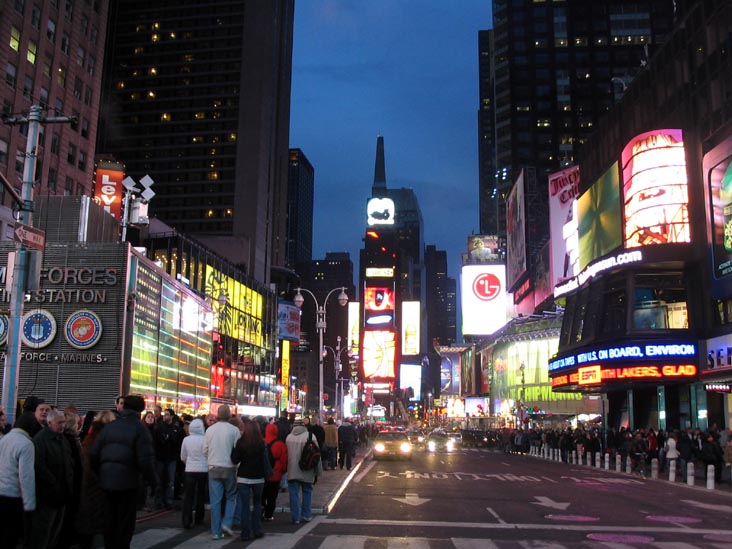
Why I Hate Times Square


I did not see this movie.

This was both the second year I spent New Year’s Eve in New York City and the second year I made sure to stay as far away from Times Square as possible. Only this time, it wasn’t enough to just stay away from Times Square. I also felt the need to have multiple conversations with my friends about why I wanted to stay away from Times Square and how I couldn’t imagine why anyone in their right mind would ever voluntarily go spend eight hours in such a crowded, cold, bathroom-less place.

In short, I don’t like Times Square very much, and the occurrence of yet another New Year’s Eve gave me an opportunity to think about why.

It’s not the tourists. Yes, they make it exceedingly difficult to walk, and yes, I become incensed every time I see someone stop in the middle of a crowded sidewalk to take a picture of the M&M store, but Times Square is a tourist attraction. If I got angry with tourists for visiting Times Square, I would have to retroactively get angry with myself for visiting the Eiffel Tower in Paris, the Space Needle in Seattle, the Lincoln Memorial in DC, etc., etc. I hate mankind and myself for plenty of things already. I don’t think I can handle adding “visiting tourist attractions when you’re a tourist” to the list.

No, the reason I hate Times Square is the same reason I hate Paris Hilton (sorry if that reference is too dated): it’s famous, but it doesn’t deserve to be. In other words, I don’t begrudge tourists for visiting it; I just don’t understand why they visit it in the first place. I’ve been there plenty of times (rarely by choice, just so you know that this piece isn’t a giant exercise in hypocrisy), and the most complimentary thing I can think of to say about it is that it looks kind of cool at night when everything is lit up.

Apart from that, it’s always appeared to me as nothing more than a collection of larger and more neon versions of stores that exist pretty much everywhere else in the country. The logic of going to New York City and eating at an Olive Garden even though the food is going to taste exactly the same as it did in Davenport except hey look at how cool the sign is at this one completely escapes me and brings back memories of Michael Scott’s first trip here. If you’re in the mood for Italian food, why not go to, say, Little Italy? Or pretty much anywhere. As Jon Stewart once pointed out, New York is a pretty good place to get Italian food.

The same could be said about the McDonald’s, the T.G.I. Friday’s, and, yes, even the M&M store. I’ll admit that it offers more variety than your typical candy shop, but ultimately, a bag of personalized mauve M&Ms is going to taste about the same as a bag you buy from CVS.

CVS, by the way, currently operates over 7,000 stores across the United States.

I can’t imagine this will actually change anyone’s mind about Times Square, given that it’s been famous for over 100 years and I haven’t gotten recognized on the street since I switched to contacts in 2005 and stopped getting mistaken for Harry Potter. But on the off chance that anyone reads this who’s thinking about visiting New York City, please trust me: there are several better tourist attractions to go to than Times Square.

Unless Olive Garden is doing its Never Ending Pasta Bowl promotion. That deal is too good to pass up. The trick is to order a bowl after you aren't hungry anymore, have one bite, and then take it home. Boom: second dinner.

Monday, January 23, 2012

On The Bro'd

(This is a profile I wrote of funny person Mike Lacher for my Cultural Affairs class at Columbia back in December. You can check out the tumblr account/book that it focuses on here and read the profile directly below these parenthetical remarks.)

In 1957, The New York Times boldly proclaimed that the publication of Jack Kerouac’s On The Road was “a historic occasion.” The nation’s paper of record praised his tale of Sal Paradise and Dean Moriarty—the alter egos for Kerouac and Neal Cassady, respectfully—traveling back and forth across the American landscape as “the most beautifully executed, the clearest and the most important utterance yet made by the generation Kerouac himself named years ago as ‘beat,’ and whose principal avatar he is.” The prophet of the twentysomethings had spoken, and it turned out that what he had to say was intelligent, poetic, and inspiring.

Blogger turned author Mike Lacher sees it a bit differently.

“A lot of the stuff they do in that book is just bro stuff,” he said, referring to the characters’ frequent bouts of drinking, partying, and hooking up. “It just happened to be that they wrote really well and were crazy. So then they were able to be beats instead of bros.”

Although a precise definition of bros is difficult to pin down (Urban Dictionary currently has 220 options), most people can agree on the following: they emerged on America’s cultural scene sometime in the past decade; they are extremely and vocally fond of indulging in alcohol, revelry and sex; they tend to be males in their late teens or twenties; and they enjoy the music of Dave Matthews, the writings of Tucker Max, and the humor of Dane Cook.

Late in 2010, Lacher decided to combine the latent bro tendencies in Kerouac’s seminal work with the blatant bro ethos of today. The end result was On The Bro’d, a parody of On The Road written in bro-speak that started as a tumblr account and will be published as a book this coming spring. Dean is now a Beta Phi Omega brother from Arizona State, and although the only ones for Sal in the 1950s were those who “burn, burn, burn like fabulous yellow roman candles exploding like spiders across the stars,” he is now more intrigued by those who “chug, chug, chug like fucking awesome players exploding like spiders across an Ed Hardy shirt.”

“That’s the part that makes it most appealing,” said Lacher. “Hearing that contrast between what’s sort of accepted as higher literary culture interacting with the lowest form of slang.”
 * * *
Lacher himself does not give off the appearance of a bro. He is tall, fair-skinned, thin, and unassuming, making him a much better fit for an NBC sitcom than an MTV reality show. Nevertheless, he has been informally learning about the social group since his college years at the University of Michigan.

“I went to a Big Ten school,” he said. “As soon as you’re at that first fraternity party, it’s like, ‘Oh, this is really just a type of human being.’”

Lacher moved to Chicago after graduating in 2007, where he planned to work at his friend’s restaurant while performing improv in his spare time. The restaurant wouldn’t hire him, though, and he was forced to fall back on a skill he had learned earlier as a favor for his mom: flash development.

“The previous year, my mom needed me to build her a flash website, so I learned flash for that purpose,” he said. “Pretty much every job that I’ve had has depended upon that skill.”

Shortly after his failed attempt at gaining employment in the food service industry, Lacher got hired at NogginLabs, a company that builds custom e-learning software. He still made time to perform improv on the side and continued doing so until moving to New York with his girlfriend “for fun” in October 2010. Around the end of 2009, however, he started growing less interested in the comedic potential of improv and more interested in the comedic potential of the Internet.

“It feels like unconquered territory,” he said. “Everyone has already done plenty of good improv shows…but people are still figuring out what you can do that’s funny on the Internet.”

Lacher took it upon himself to try figuring this out and has so far come up with a variety of answers. An application that could transform any website into a Geocities page straight out of the mid-90s was funny enough to receive over 600,000 visits in its first week and merit a mention in The New York Times Magazine. A tumblr account featuring images of Michael Bublé getting stalked by a velociraptor made it into GQ. And the equally self-explanatory Muppets with People Eyes got written up by Time.

The one thing most of these projects had in common, according to Lacher, was that their time in the spotlight didn’t last long.

“People have a short attention span on the Internet,” he said, “and also, those single serving websites…I think they’re just not that funny after a while.”

These were Lacher’s initial expectations for On The Bro’d. Born out of his simple observation that “road” and “bro’d” rhyme, he thought it would entertain both him and the Internet for a brief period of time before they each moved onto something else.

Thus, approximately one year ago, Lacher launched On The Bro’d as another one of what he calls his “one-joke tumblr things.” By the initial post—a parody of, appropriately enough, On The Road’s first paragraph—he had already firmly established the tone: Sal’s “serious illness” was replaced with “a wicked fucking hangover,” while Dean was shrouded in Axe Body Spray instead of mystery.

This strong, humorous voice was enough to convince Hannah Gordon, a literary agent with Foundry, that Lacher’s most recent project had more potential than a series of photoshopped Muppets. She first heard about the fledgling tumblr account from one of her colleagues, and unlike Lacher himself, she did not see it as just a one-joke tumblr thing. She saw it as a book.

“You kind of have to go with your gut on these things,” Gordon said. “If you’re really enjoying it, and you want to keep reading it, you can’t think, ‘Oh, I’m the only person out there who would like this.’ You have to imagine there are pockets of people who think like you do.”

The Internet has recently become a great resource for literary agents trying to find new clients, said Gordon, especially in the wake of fruitful blog-to-book deals such as Stuff White People Like and Awkward Family Photos. However, both Gordon and Brendan O’Neill, Lacher’s editor, acknowledged that these past success stories do not automatically mean a blog that turns into a book will be a hit.

O’Neill, who works at Adams Media and has previously edited book versions of popular blogs, said the biggest factor regarding the ability of these projects to sell effectively boils down to whether or not the author has the ability “to write and write funny.

“I think Mike’s able to do that,” he added.
 * * *
Although Lacher had not considered turning On The Bro’d into a book before Gordon contacted him, he was very receptive to the idea. The two put a proposal together, and Adams Media—a publishing company that has previously printed literary parodies such as The Stoned Family Robinson and Bad Austen: The Worst Stories Jane Never Wrote—decided to buy it during the winter of 2011. Now, all Lacher had to do was write the thing, a process he said went “pretty well.

“It had its ups and downs,” he continued. “Getting to try to use that Kerouac-y poetic cadence but with bro stuff is fun. But there’s other parts where it can reach a certain tedious level where every day it’s like, ‘How do I rephrase this?’”

Lacher frequently referred to numbers when describing how he wrote On The Bro’d. There were 240 pages in total; he tried to write at least two pages per day; and it took him approximately 40 minutes per page. This mechanistic update of Kerouac’s three-week typing binge enabled him to finish his first draft in August, which he is currently waiting to get back from Adams Media.

“I’d usually try to wake up at six and get some done, and then try to get whatever else done at night,” Lacher said. “That was the part where it just got exhausting because it’s like you wake up and work, then go and actually work, like in an office, and then come home and work more. I know there definitely were times where people from work would be like, ‘Hey, we’re going out!’ and then I’d be like, ‘I can’t. And I also can’t begin to explain to you why.’”

Lacher currently works at Google doing rich media banner advertising, having left NogginLabs this past January. Although he is happy in his current position, he does wonder if having a good job at one of the world’s most highly valued companies has prevented him from developing the same drive as other writers.

“I don’t feel like I’m a struggling bohemian artist,” he said, “which I guess on one hand would maybe make me claw and scratch my way to the top harder. But on the other hand, it doesn’t make me feel like I’ve got to achieve ‘x’ goal right now.”
 * * *
The fact that a version of On The Road retold for bros is now viewed as a viable commercial product is a clear indication that bros have become an established part of American life, as is the popularity of TV shows like Entourage and How I Met Your Mother, movies like The Hangover and Old School, and websites like BroBible and My Life Is Bro. At this point, it seems, the bro has been around for long enough to fully infiltrate the mainstream. Recently, however, Lacher believes a relatively new element has found its way into bro culture: pride.

“I think there’s definitely more of a self-identification now that’s made it cooler to be that sort of dude who loves to party and loves to be concerned with his appearance as well,” he said.

Streeter Seidell, Editor-in-Chief of CollegeHumor—a company he describes as “implicit in the brosplosion”—agrees.

“I feel like bros are aware that they’re obnoxious and dumb and annoying, but they kind of take pride in that a little bit,” he said. “They’ve become self-aware.”

On The Bro’d seems far too tongue-in-cheek to contribute to the nascent bro pride movement, a reflection of Lacher’s overall attitude toward bros as harmless sources of amusement. However, that did not stop BroBible—the Internet’s self-proclaimed “ultimate destination for bros”—from referring to it as “a fantastic and hilarious read.” It was a move that startled Lacher and suggested that the emergence of bro pride does not necessarily mean bros have started taking themselves seriously. Otherwise, it seems difficult to understand how they could be complimentary of a book about them filled with passages like, “But the way I picked cotton was sorta retarded. I took like forever trying to pick the white shit off the other shit; everybody else did it way faster.”

Before getting praise from BroBible, Lacher said, he had always assumed that bro was an exclusively disparaging expression. Now, he recognizes the word as “something that’s taken both as a positive and a negative. People who are labeled bros will happily accept it, and other people will use it as a derogatory term.”

Seidell thinks this incongruous combination of bros being simultaneously proud and mocking of their identity is a sign that the archetype may not be prominent for much longer. As evidence, he points to one of the hallmarks of bro culture: an episode of Jersey Shore.

“There’s a point where Pauly D and Vinny are doing characters of guidos,” he said, “and they’re heightened, but they recognize that they’re also guidos. But they’re like, ‘We’re the good kind.’ And I was like, ‘Oh, man. It’s become meta now, and people kind of hate meta after a little while.’”

Still, Seidell said, he may just feel this way about bros because of the large role they’ve played in his job for years.

“I’ve been so immersed in it for so long that I’m…sick of it,” he said. “Bro humor could just be hitting in other places.

“So who knows, man? It could stick around forever,” he continued. “You want to do shots?”